

TikTok Shop
#Featured TikTok Shop

Search behavior is changing rapidly. Users increasingly expect immediate, relevant answers instead of clicking on search results. Thanks to AI-driven search engines like ChatGPT, Gemini, and Google SGE, new ways to gain visibility are emerging—even without clicks. Generative Engine Optimization (GEO) addresses this trend: it’s a method of content optimization that ensures AI platforms include your brand in their generated responses. In this blog, you’ll learn exactly what GEO is, how it works, what role branded SEO plays in this, and what recent developments—such as AI Overviews—mean for you.
Generative Engine Optimization (GEO) is the process of structuring your content so that AI search technology includes your information in automatically generated answers. Instead of competing for a high ranking in traditional search results, GEO focuses on being present in the final answer that the user sees. You want AI to recognize your content as reliable, relevant, and useful. This requires more than just good keywords. GEO demands structure in your text, clear language, and substantive depth. Timeliness, source attribution, and the structure of your page also play an important role. The better these elements align, the greater the chance that your brand will be selected as a source for the answer.
To fully understand GEO, it’s important to know how generative search engines process information. AI platforms like ChatGPT or Gemini don’t display a list of links like traditional search engines do. Instead, they immediately provide a synthesized answer to the user’s query. These answers are based on vast amounts of online content and are constructed from information sources that the AI considers reliable, clear, and relevant.
The system takes several factors into account. The structure of your text must be clear, with logical headings and well-organized paragraphs. The content must address the user’s query. Reliability is also crucial: content with a clear author, publication date, and external sources is more likely to be used as a starting point. Finally, writing style plays a role. AI is more likely to choose texts that are written in an accessible and human way rather than dry, technical pieces.
SEO and GEO complement each other but differ in several key ways. While SEO is about being recognized by traditional search engines like Google, GEO focuses on visibility within AI-generated answers. This requires different choices in your content strategy: less focus on keywords and links alone, and more on structure, context, and reliability. The underlying technology and the goal differ. Below, you can see how these two strategies relate to each other.
Generative AI is changing the way people gather information. Instead of clicking through search results themselves, users expect immediate, curated answers from systems like ChatGPT and Gemini. In this new reality, the role of SEO is shifting: it’s no longer just about rankings in search results, but about being visible within the answers that AI generates.
For businesses, this means a fundamental shift in strategy. Content must not only be optimized for search engines but also be clear, reliable, and substantively strong enough to be selected as a source by AI models. Rather than focusing solely on keywords and metadata, this development requires building content authority. This is the only way to remain relevant in a landscape where AI is increasingly becoming the first—and sometimes only—point of contact.
GEO is not a luxury, but a necessity for brands that want to remain visible online at a time when AI is taking over the decision-making process. Instead of clicking on search results, users are presented with answers directly. If your brand isn’t among them, you’ll miss out on visibility when it matters most. By creating branded content, you ensure your name is included in the answer and that you’re actually recognized as the source. At the same time, you strengthen your authority because AI models favor reliable sources with up-to-date, well-structured content. And now that AI tools like Perplexity, ChatGPT, and Google SGE are being used more and more frequently, new gateways to your brand are emerging—beyond your website. Brands that understand and apply this now have a competitive advantage in a playing field that is still rapidly evolving.
It’s important not to view GEO as a standalone strategy, but as part of a broader AI-first SEO approach. By 2025, SEO will be built in layers: from being visible in AI Overviews (AEO), to being cited in AI answers (GEO), producing scalable content (AIO), to optimizing the user experience (SXO). The visual below (in Redkiwi style) shows how these layers complement and reinforce each other in the modern search engine landscape.
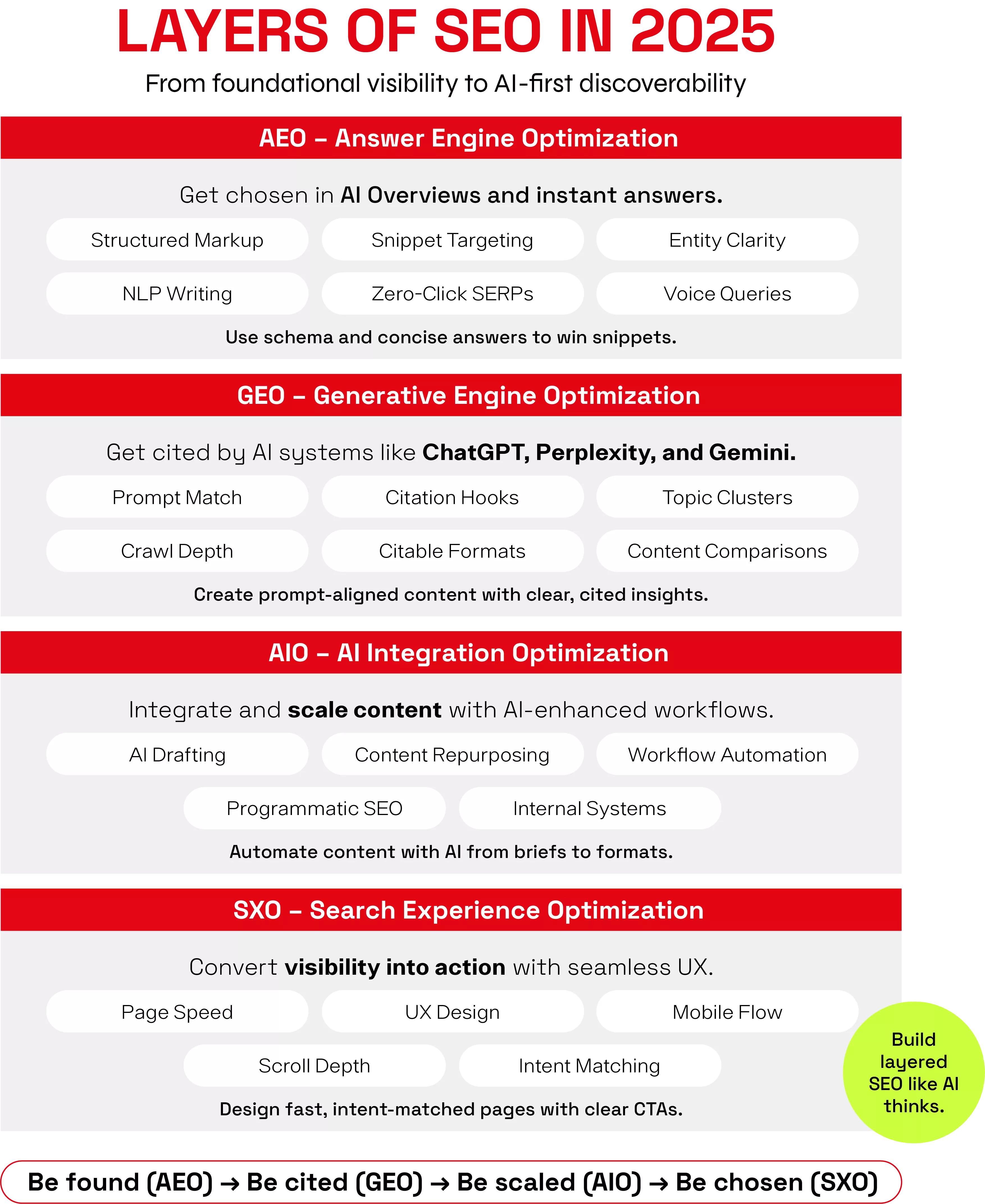
The rise of generative search engines is fundamentally changing search behavior. Users are increasingly asking complete questions instead of using individual keywords, and expect an immediate answer rather than a list of links. As a result, the orientation process is shifting from websites to AI platforms, which function as new gateways to information. This makes it more important than ever to create content that aligns with your target audience’s information needs and language, so that AI recognizes your brand as a reliable source and includes it in its response. Branded SEO is a powerful tool in this regard, as it allows you to actively weave your brand into substantive answers.
The rise of AI platforms such as ChatGPT, Gemini, and Perplexity is fundamentally changing search behavior. Users are increasingly formulating complete questions in natural language and expect direct, summarized answers without having to click through a list of search results. This shifts the information-seeking process from websites to AI-generated answers, causing traditional SEO metrics such as click-through behavior and rankings to lose their significance.
At Redkiwi, we actively track this shift. Using tools like BrightEdge, we identify which keywords appear in AI Overviews, People Also Ask, Featured Snippets, and other SERP features. We not only see where you’re visible but also where you have the potential to be included. For one client, for example, we identified 43 keywords already mentioned in AI answers, compared to over 1,400 search terms with potential.
By combining these insights with data on content structure and semantic coverage, we can make targeted adjustments. This way, we make GEO not only measurable but also actionable for brands that take AI visibility seriously.
GEO may sound complex, but you can get started with it today. Here are some practical first steps to make your content AI-proof:
Use clear H1, H2, and FAQ sections
Use natural language; avoid jargon
Such as FAQ Page or HowTo schema markup
Show who the author is, cite sources, demonstrate expertise
AI also reads alt text and captions
AI tools prefer up-to-date information
The future of search behavior is generative. That doesn’t mean SEO is going away, but it does mean that GEO is becoming an essential part of a modern content strategy. Do you want to ensure your brand is visible in AI-generated answers? At Redkiwi, we help businesses with a practical and forward-thinking GEO approach, from content structure and semantic optimization to implementing AI-friendly data.
TikTok Shop
It’s that time again: Shopify has launched Shopify Editions Spring '26.
Shopify Editions Spring '26
On June 19, 2026, a major change will take effect that every B2C online store in the Netherlands will need to address.
Required: Digital cancellation feature
By 2026, “Hey {{first_name}}” won’t feel personal anymore—it’ll feel like the bare minimum and, secretly, a little lazy.
Hyper-personalization with AI